 Astro Explorer
Curiosity · Connection · Learning
This isn't a studio's app — it's a universe built in the open. The best worlds and places here come from what explorers ask for next.
Shaped by the people who explore it.
An Astroshort app
Start at a black hole. Fly all the way home.
Fly between planets, drill into real places on Earth, Mars and the Moon, and hear every fact read aloud — each one sourced from NASA. Runs offline. Never shows an ad, never asks who you are.
Free on the App Store — no ads, no accounts, works offline.
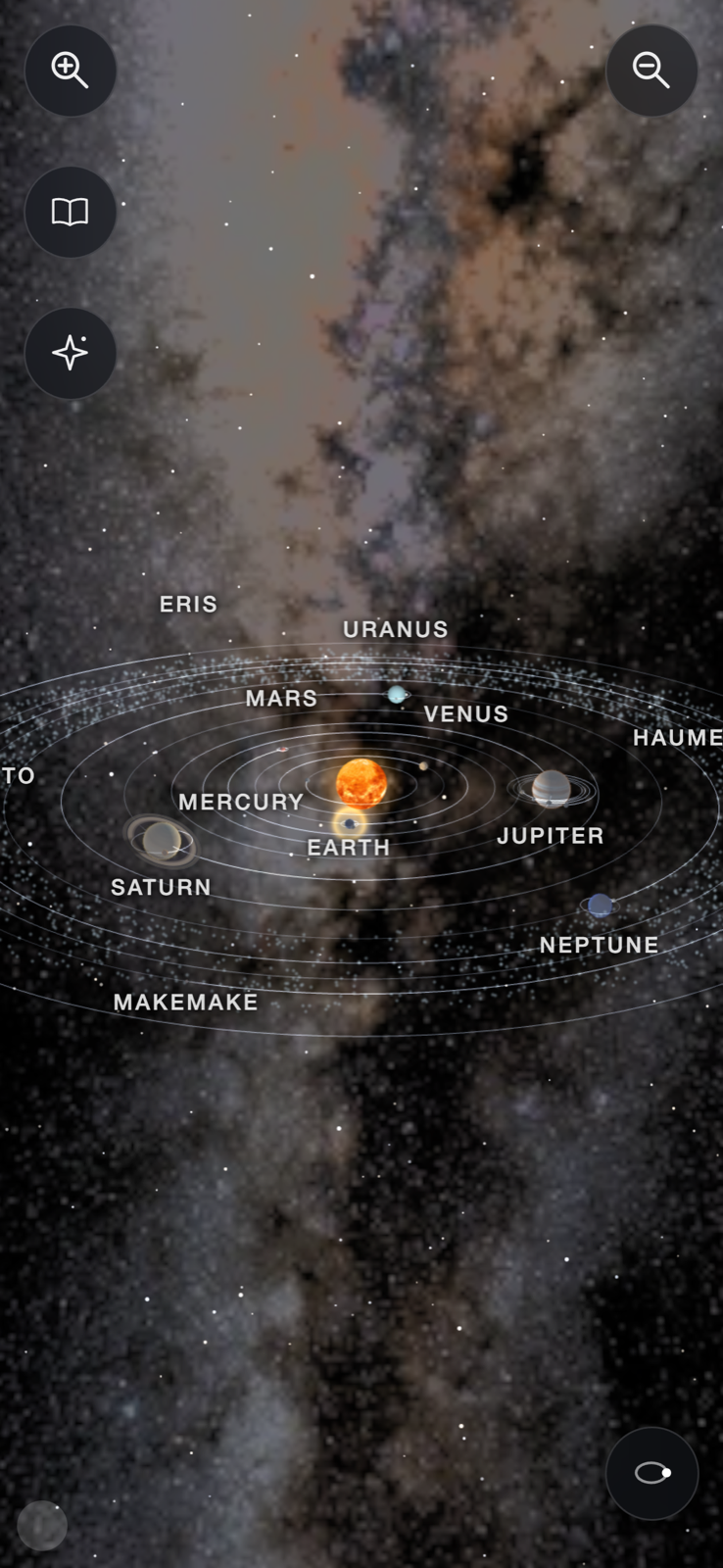


Real screens from the app — no mock-ups. New captures coming with the next update.
What's new · July 2026
AstroShort 1.0 is live — and the next free update is already with Apple.
The full hand-built solar system: fly between worlds, drill into real places on Earth, Mars and the Moon, and hear every fact read aloud. Free, offline, no ads, no accounts.
Hawking radiation, dark energy and dark matter — told honestly, with progress points, sources, and a plain red stamp on anything that's still a prediction.
Little missions that guide the exploring: find, compare and discover — with a winner's stamp at the end. Arrives automatically the moment Apple approves.
Why people trust it
Private by design. Honest by rule.
The whole solar system runs offline. No wifi, no signal — no problem.
Nothing is sold, and nobody is buying your attention.
Open it and explore. No email, no sign-up, no profiles to manage.
Zero analytics, zero telemetry. Their exploring stays on the device.
A warm voice narrates every world, so a pre-reader can explore alone.
The whole universe, free. No unlocks, no subscriptions, no catch.
The single exception to “nothing leaves the device”: an optional daily discovery feed of real rocket launches and Earth events, fetched with a plain, anonymous request — no cookies, no identifiers. Turn it off and the app is fully offline. Read the two-minute privacy policy.
The narrator
Tap a world and a warm, natural voice says its name and tells you something true — so an explorer who can't read yet never needs a grown-up to keep going. Have a listen:
Recorded from the app — this is the actual voice you'll hear in the app.
A real look inside
Start at the Sun, drift out past the planets and their moons, and don't stop until you reach a real black hole and the galaxies beyond. Every image below is a real screen from the app.
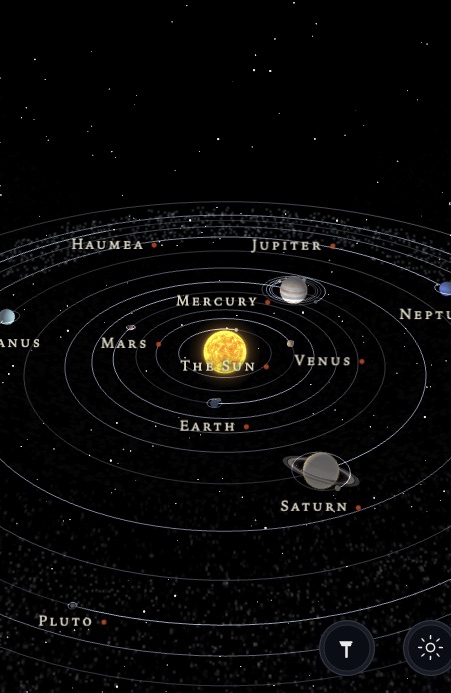
The Sun, all eight planets and their moons — tap any world and fly straight to it.
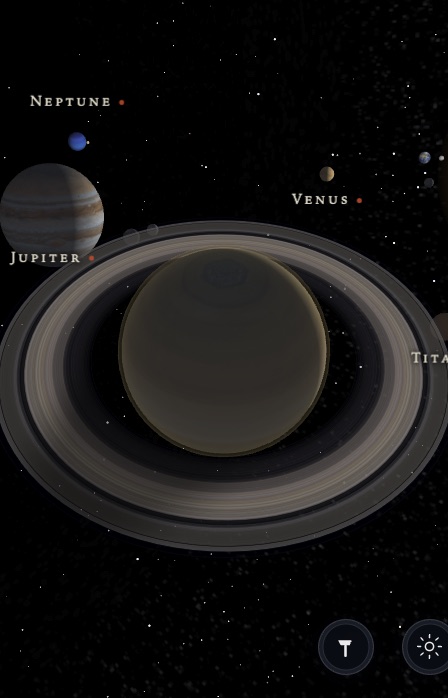
Rise up to any planet and open its plate — Saturn's rings, its moons, and the facts that make it strange.
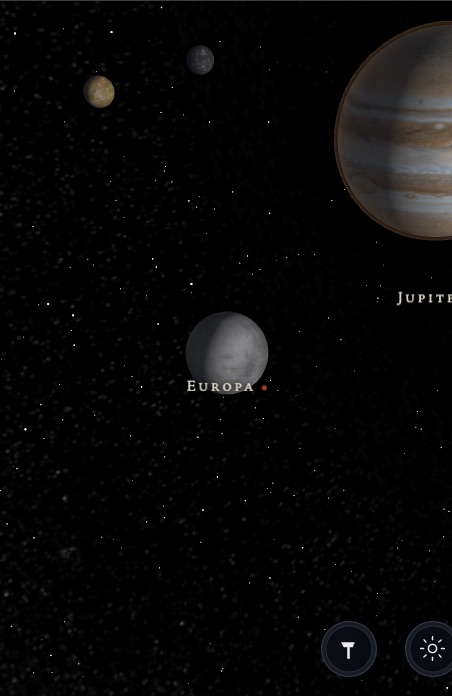
Europa, Titan, our own Moon — dozens of worlds circle the planets, and you can visit them all.
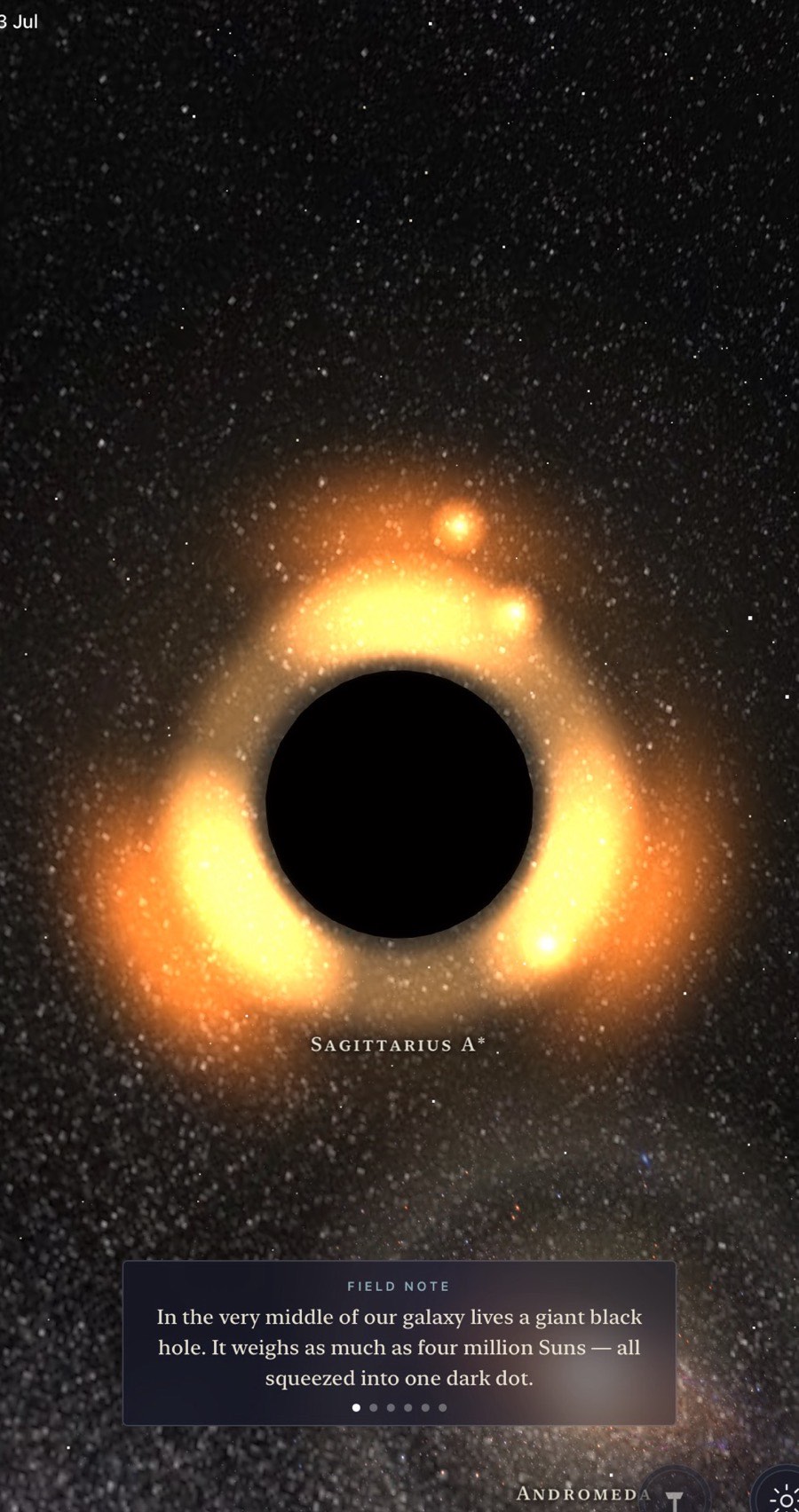
Sagittarius A*, the giant black hole at our galaxy's heart — with the real Event Horizon Telescope photo on its plate.
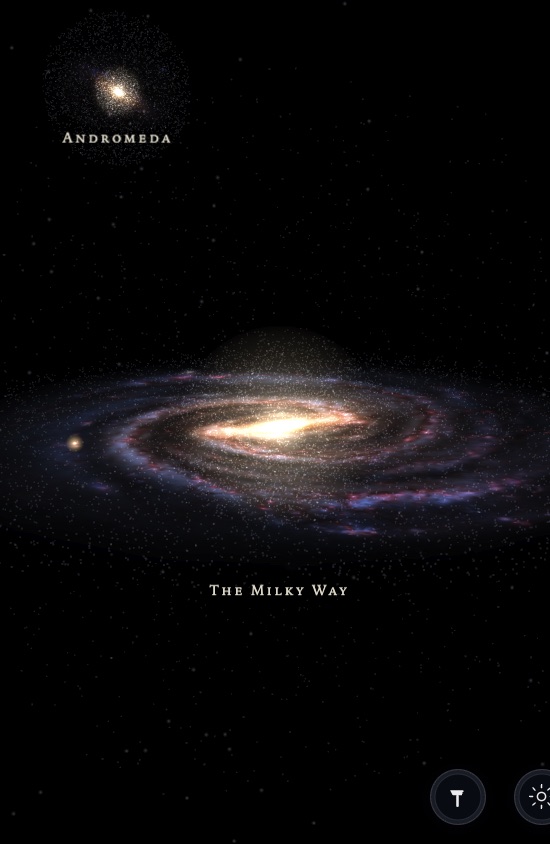
Keep pulling back until the Sun is a speck, our galaxy's core glows, and Andromeda drifts into view.

Drill into Earth, Mars and the Moon — Uluru, coral reefs, the Apollo landing sites — each a real place with a real photo and a sourced story.
The ancient river delta at Jezero Crater on Mars, where NASA's Perseverance rover landed — the same image scientists study, told in plain language.
What makes it good
Explore
The Sun, all eight planets and the Moon — tap a world and fly to it. Zoom from a planet's surface all the way out to the galaxy.
Navigation never needs reading. A pre-reader can pilot the whole universe alone.
Go inside
Earth, Mars and the Moon aren't just spheres — drill in to real places: Uluru at sunset, Jezero Crater's ancient river delta, coral reefs, the Apollo landing sites.
Each one carries a real photo and a story you can trust, with the source attached.
It comes alive
In Kid mode, planets put on little shows and creatures appear where they really live — the northern lights flare, and a place you've flown to comes alive.
In Explorer mode it all stays calm and premium. Wonder, tuned to the room.
Two modes
Explorer is the default: a clean, engraved star-atlas look where grown-up facts and the daily feed are one tap away.
Kid is a playful picture-book skin for little hands, with the deeper facts tucked safely behind a parent hold-gesture.
Size comparison
Put any two worlds side by side and watch the scale finally land — the kind of “wait, what?” moment a picture in a book can't give you. And the Sun? It would swallow 109 Earths across.
Source — NASA planetary fact sheets
Grounded in real science. Sizes, distances, moons and temperatures come from NASA planetary fact sheets and the IAU, and every fact shows its source. Where we stylize scale so tiny planets stay visible, we say so — but the truths always hold: Jupiter is always the biggest, Mercury always closest to the Sun. Spot something off? Tell us, and we'll fix it.
Curiosity · Connection · Learning
This isn't a studio's app — it's a universe built in the open. The best worlds and places here come from what explorers ask for next.
Built together
Astro Explorer grows in the open. The best worlds and places here come from what its explorers ask for next. See something missing? Ask, and watch it arrive.
Say it out loud — “I want dinosaurs!” Their words become text right there on the device. Nothing is recorded, and no sound ever leaves the phone.
Every idea is reviewed on the device before anything is sent — nothing leaves without an explicit tap.
Popular ideas get built and arrive as free updates, often within days. You asked; it shows up — the thing you wished for, turning real.
Every idea joins the Builders Board — a shared wish-list inside the app where explorers everywhere can see what the whole community is curious about. No names, no profiles, no accounts: just wishes, gathered together. A small sense of connection, and the quiet thrill of watching something you asked for get made.
Real science, honestly told, free for everyone — that’s the whole idea.
Free on the App Store — no ads, no accounts, works offline.